
Lead in Tile Glaze: What It Is, Why It's There, and What We Test For
Traditional glazes have used lead for centuries - it's what gives handmade tile its depth of colour. That doesn't make it something to wave away. Here's the whole picture: why lead turns up in glaze, what our own safety data sheets actually say about our ranges, and when it genuinely matters.
Tiles of Ezra; Materials & Testing
If you've spent any time reading about zellige or other handmade glazed tile, you've probably seen the word “lead” attached to it somewhere - often in a comment thread, sometimes in a headline designed to alarm. We're not going to pretend that conversation doesn't exist, and we're not going to have it quietly. Some glazes contain lead. Some of ours do too. This page explains why, what it means in practice, and exactly what our testing shows for every colour we sell, including the ones with numbers on the higher end.
We'd rather you read this here than piece it together from a forum.
1. Why lead ends up in glaze at all
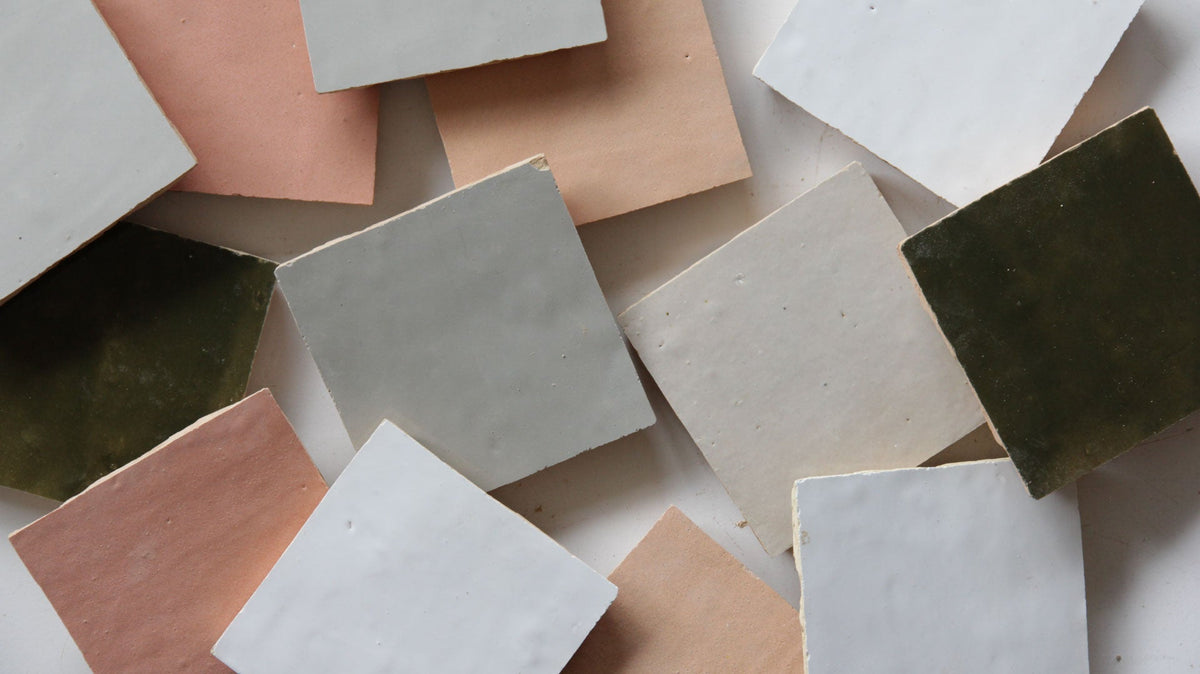
Glaze is glass. To turn powdered minerals into a glossy, durable surface, a kiln has to melt them, and some minerals melt at brutally high temperatures. Lead oxide has one job in traditional glaze chemistry: it acts as a flux, dragging the melting point down so the glaze matures at a lower, gentler heat. That gentler firing is exactly what lets handmade tile keep the slight unevenness, the pooling, the depth of colour that a mass-produced tile can't replicate. It's also what makes certain saturated colours - deep cobalt, rich chocolate, the near-black glazes - genuinely difficult to achieve without it.
This isn't a shortcut or a manufacturing defect. It's a technique going back thousands of years, still used deliberately by artisan kilns across the world, including many of the workshops that hand-glaze traditional Moroccan zellige. Lead in a glaze is a choice a maker makes for colour and character, not an accident, and not something hidden inside the tile by default.
“Lead isn't the villain of this story by itself. What matters is how much is there, how it's fired, and whether anyone actually checked.”
2. Total content vs. what can actually leach out
This is the distinction that gets lost most often, so we want to be precise about it. There are two different things you can measure:
• Total lead content: how much lead is chemically present in the glaze material itself, measured as a percentage or in parts per million (ppm). This is the figure that appears on our Safety Data Sheets (SDS), prepared to Safe Work Australia's Code of Practice, and it's the number relevant to workplace handling - cutting, grinding, drilling.
• Leachable lead: how much lead can actually migrate out of a fired, vitrified glaze surface under real-world conditions, typically measured with an acid-soak test such as ASTM C738. This is the figure that matters for food-contact surfaces like mugs, plates, and benchtops.
A properly fired glaze locks lead into a stable glass matrix. Total content and leachable content are related, but they are not the same number, and a glaze can carry a measurable total lead content while releasing almost nothing under normal use. We publish total content - the more conservative, precautionary figure - because it's what our SDS documentation measures, and because giving you the cautious number is more honest than giving you the flattering one.
3. What our own testing actually shows
Every range we sell is independently documented with a Safety Data Sheet, and every SDS states lead content per colourway - not as a single blended figure for the whole range, but broken down colour by colour, because the amount of lead in a glaze changes with the pigment and depth of tone. We publish these in full and will send you the SDS for any range on request. Here's a summary of where things sit across three of our current collections.
|
Range |
What we found |
Typical span |
Status |
|
Tierra |
All ten colourways |
<0.01% (<100 ppm) |
Lead-free |
|
Amano |
All colourways, incl. Chocolate & Azul |
<0.01% (<100 ppm) |
Lead-free |
|
Zellige |
7 colourways (Chameleon, Clay, Dust, Latte, Olivia, Sal, Stratus) |
<0.01% (<100 ppm) |
Lead-free |
|
Zellige |
Mid-toned colourways (e.g. Chefchaouen, Cool Breeze, Moss, Teal) |
0.04% – 0.21% |
Moderate |
|
Zellige |
Deepest, most saturated colourways (e.g. Chocolate, Mustard, Kermit) |
0.22% – 3.00% |
Higher |
Notice what that table doesn't do: it doesn't quietly average the range into one reassuring number. Our lightest, most neutral Zellige tones test at true lead-free levels. Our darkest, richest tones - the colours getting their depth from that same traditional flux - carry more, up to 3.00% in our most saturated colourway. That's consistent with what's reported across the traditional zellige industry generally, where deeply pigmented, hand-fired glazes can test considerably higher again. We'd rather show you the full spread than pretend it's flat.
4. When it's actually worth thinking about, and when it isn't
Lead content on a spec sheet and lead exposure in your home are two different questions. Here's how we'd separate them.
Generally not a concern
• Installed, intact glazed tile on floors, walls, or shower surrounds under normal daily use
• Walking, showering, or general contact with an undamaged glaze surface
• Any colourway from our lead-free ranges, in any application
Worth being deliberate about
• Cutting, grinding, or drilling tile, this creates dust, the primary real-world exposure route
• Food-contact surfaces (benchtops, splashbacks tiles will actually touch food on)
• Chipped, cracked, or heavily worn glaze that exposes the tile body
• Homes with young children who mouth surfaces, in low, high-traffic areas
For the cutting and drilling scenario specifically: this applies to every glazed tile on the market, lead content aside, because our SDS documents also flag crystalline silica dust as a serious inhalation hazard under WHS regulations. Wet-cutting, HEPA extraction, and a properly fitted respirator aren't a lead-specific precaution, they're standard practice for any trade cutting glazed or natural stone tile, and we include this guidance with every SDS we send out.
5. How we handle it, in practice
We don't think “trust us” is good enough on a topic like this, so here's what we actually do:
• Every range is independently tested, and results are documented per colourway on a formal Safety Data Sheet - not a marketing summary.
• We publish the numbers that don't flatter us alongside the ones that do. The Zellige Kermit figure above is on our own SDS; we're not going to leave it off this page.
• SDS documents are available on request for any range or colourway, so you - or your builder, or your tiler - can see the primary data yourself, not our summary of it.
• We maintain a dedicated lead-free shopping section, so if a project involves a benchtop, a food-prep splashback, or you'd simply rather build with lead-free colourways throughout, you can shop that requirement directly instead of cross-checking every product page.
A note on where these numbers come from
The figures above are total lead content, prepared under Safe Work Australia's Code of Practice for Safety Data Sheets and classified against AS 4361.2 - the standard used for workplace handling and transport classification. They are not a food-contact leach test. If a project specifically requires leach-tested, food-contact certification (for example, a benchtop or servingware application), tell us the use case and we'll point you to the right documentation or the right product for it.
6. The short version
Lead has a real, technical reason for showing up in traditional glaze, and it isn't automatically dangerous, vitrified into a glass surface, in a floor or wall application, intact and undisturbed, it's simply not doing much. It becomes worth managing when tile is cut or damaged, or when it's going somewhere food will sit on it directly. We'd rather hand you the actual numbers, the actual standard they're measured against, and a clearly signposted lead-free option than let you find out any of this from somewhere else.
Building somewhere lead-free matters?
Shop our dedicated lead-free collection via our Navigation, or have a read of the Lead levels for these ranges below
- Read SDS Sheet on Tilesofezra tested Tierra Ceramic Here
- Read SDS Sheet on Tilesofezra tested Amano Ceramic Here
- Read SDS Sheet on Tilesofezra tested Moroccan Zellige Here
Standards & references
Safe Work Australia — Code of Practice: Preparation of Safety Data Sheets. AS 4361.2:2017 (lead classification, workplace). ASTM C738 (lead & cadmium extraction, food-contact glazed ceramics). Tiles of Ezra Safety Data Sheets — Zellige, Tierra & Amano ranges, current editions.